
Science Cases
Contents
LSB features
Stellar Halos
Stellar Streams
Low Surface Brightness Features
ARRAKIHS will detect and characterise low surface brightness features (LSBFs) such as stellar streams, shells, plumes, and tidal tails in the outskirts of Milky Way–mass galaxies. These low surface brightness features become visible in deep images as coherent structures that present a wide variety of shapes and brightness levels. These structures are the visible signatures of past accretion events and provide a direct view of how galaxies grow through interactions and mergers.
Cosmological simulations predict that the number and diversity of these features increases rapidly with imaging depth. At the sensitivity of ARRAKIHS, typical Milky Way–mass galaxies are expected to host a small number (∼1–2) of detectable coherent structures, with significant variation from galaxy to galaxy depending on their individual assembly history.
These features trace recent and ongoing accretion events and are therefore highly sensitive to the timing, orbit, and mass of the galaxies that were disrupted. Their morphology, spatial distribution, and surface brightness encode the physical processes that shaped the outer regions of galaxies and their dark matter halos.
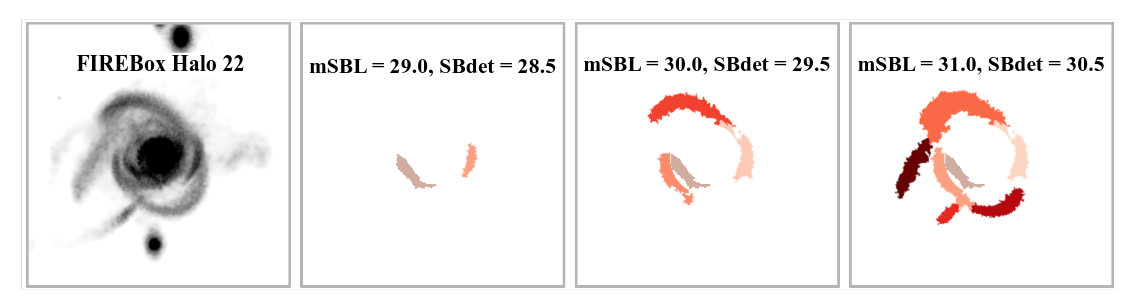
ARRAKIHS will provide the first homogeneous survey of LSBFs across a statistically representative sample of galaxies, allowing us to quantify how common different types of structures are, and how they relate to the overall growth of galaxies.
Beyond structure alone, ARRAKIHS multi-band imaging will provide basic stellar population information for these faint features. Colour measurements help distinguish between metal-poor and metal-rich progenitors, and allow comparisons between diffuse halos, coherent streams, and surviving satellite galaxies. This adds a crucial physical dimension to the structural mapping of galaxy outskirts.
Together, these measurements will provide a statistical census of accretion signatures in the low surface brightness Universe, linking visible substructure to the formation history of galaxies and their dark matter halos.
Stellar halos
The diffuse stellar halo surrounding a galaxy is a fossil record of its past. Built from stars deposited during the accretion and disruption of smaller galaxies, stellar halos preserve information about the events that shaped a galaxy over billions of years. Unlike the bright central regions, where successive generations of star formation can erase evidence of earlier evolution, stellar halos retain a long-term memory of galaxy assembly.
ARRAKIHS will obtain deep, homogeneous measurements of stellar halos around a statistically representative sample of Milky Way–mass galaxies. For each target, the mission will measure fundamental properties such as the stellar halo mass, radial extent, surface-brightness profile, shape, and colour. These quantities provide direct constraints on the amount of accreted material, the timing of past mergers, and the properties of the galaxies that contributed to the halo.
The structure of stellar halos is closely linked to the growth of their host dark matter halos. Cosmological simulations predict that galaxies with similar present-day masses can have very different accretion histories, leading to significant variations in the mass and morphology of their stellar halos. By measuring these properties across a large sample of galaxies, ARRAKIHS will quantify the diversity of halo structures and place the Milky Way and Andromeda into a broader cosmological context.
A key goal is the determination of the total accreted stellar mass contained in galaxy outskirts. This quantity provides a direct measure of the cumulative merger history of a galaxy and is one of the most powerful observational probes of hierarchical galaxy formation. ARRAKIHS will also characterize changes in halo structure with radius, identifying signatures of past accretion events preserved in the distribution of diffuse stellar light.
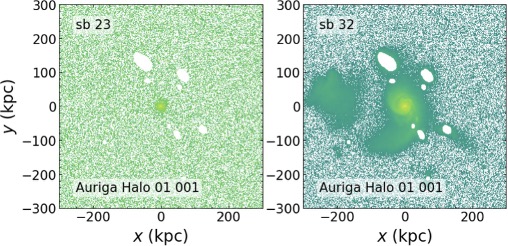
The mission’s multi-band observations will further provide information on the stellar populations of halo stars. Colours measured across the diffuse halo can reveal differences in age and metallicity, helping to identify the masses and evolutionary histories of the galaxies that contributed to its growth.
Together, these measurements will establish the first statistical census of stellar halos around Milky Way–mass galaxies, providing a critical benchmark for models of galaxy formation and the assembly of dark matter halos.
Stellar Streams: Infering the Shape of Dark Matter Halos
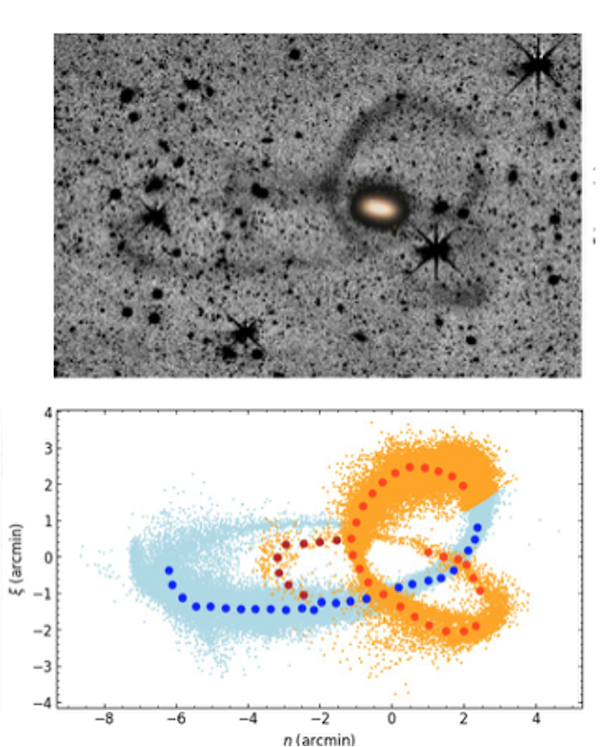
Stellar streams are long, thin structures of stars formed when dwarf galaxies are torn apart by the gravitational field of a larger galaxy. These streams can act as sensitive tracers of the underlying gravitational potential, making them one of the most powerful tools to to infer the shape and radial profile of the host dark matter’s potential in galaxy halos.
ARRAKIHS will detect and characterise stellar streams around Milky Way–mass galaxies at unprecedented depth and uniformity. The length, shape, and curvature of the long streams detected by ARRAKIHS will provide valuable clues about the gravitational potential of their host halos, allowing us to test the predictions of ΛCDM and alternative dark matter models, such as Self Interacting Dark Matter (SIDM).
Numerical simulations show that the ability to detect longer and more coherent streams increases rapidly with imaging depth. While shallow observations reveal only short segments of tidal debris, deeper imaging, such as that provided by ARRAKIHS, can uncover streams that wrap significantly around their host galaxies. These extended structures provide much stronger constraints on the shape and orientation of dark matter halos.
By comparing observed streams with dynamical models, ARRAKIHS will measure key properties of dark matter halos, including their flattening and three-dimensional structure. These measurements can be used to test predictions from the standard cosmological model and alternative dark matter scenarios.
By extending stream studies beyond the Local Group, ARRAKIHS will provide new opportunities to investigate the connection between stellar stream properties and the gravitational potential of dark matter halos. Combined with dynamical modelling, these observations will help place new constraints on the structure of dark matter halos and on models of galaxy formation.
Dwarf galaxies with ARRAKIHS data: additional science opportunities
ARRAKIHS is specifically designed to optimize the detection of extended low surface brightness (LSB) structures. However, its wide-field coverage of massive galaxy halos also enables systematic surveys of their satellite galaxy populations. Preliminary results based on ARRAKIHS mock images indicate that the detectability of satellite galaxies in the ARRAKIHS VIS2 band exceeds 80% for effective SB of 24.5 mag arcsec⁻², and remains above 50% for effective SB values as faint as 26.5 mag arcsec⁻². These detection rates are comparable to those reported for Euclid (Marleau et al. 2025, A&A, 697, A12) and SAGA (Mao et al. 2021, ApJ, 907, 85).
As highlighted in the Euclid dwarf galaxy work mentioned above, the reliable identification of dwarf galaxies from background galaxies remains a significant challenge. To overcome this limitation, the synergies between Euclid and ARRAKIHS are being fully exploited. In particular, Euclid’s superior spatial resolution will facilitate the identification of dwarf galaxies and their separation from background contaminants. Furthermore, machine-learning algorithms have been implemented and reveal that the ARRAKIHS VIS1 (blue) band provides critical information that substantially improves classification accuracy, whereas morphology alone is insufficient for robust classification. Ongoing improvements to the deconvolution algorithm and detection methods under development for ARRAKIHS are expected to further enhance satellite detectability and classification. These advancements will strengthen the complementarity between ARRAKIHS and other satellite galaxy surveys, including those conducted with Euclid.
Ancillary Science
Mission Design
Other Surveys


